Chinese State Lab Just Flew the World's First Megawatt-Class Hydrogen Turboprop Engine for 16 Minutes
 While Airbus Spent the Last Year Pushing Its Hydrogen Aircraft Timeline to 2045, a Chinese State Lab Just Flew the World’s First Megawatt-Class Hydrogen Turboprop Engine for 16 Minutes
Luis Reyes | May 27, 2026
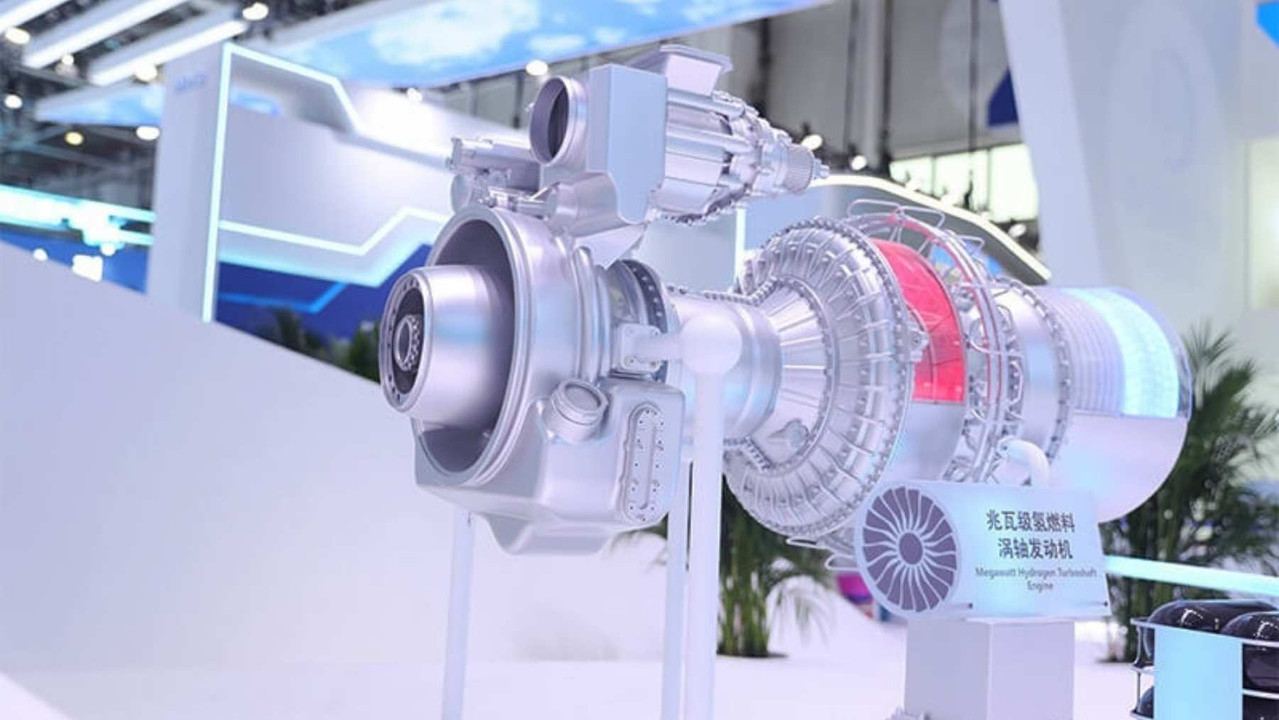
On a Saturday morning in early April, a 7.5-ton unmanned cargo aircraft called the W5000 lifted off the runway at an airport in Zhuzhou, a midsized industrial city in central China’s Hunan province. It climbed to 300 meters — about 985 feet, the kind of altitude small-aircraft traffic in the U.S. operates at over open country — leveled off, and held a cruise of 220 kilometers per hour, roughly 137 miles per hour. Sixteen minutes and 36 kilometers later, it landed. The aircraft did not run on Jet A. It ran on liquid hydrogen, stored at minus 253 degrees Celsius, fed directly into the combustion chamber of a turboprop engine that produces somewhere north of one megawatt of shaft power. The engine is called the AEP100. It was developed by a subsidiary of the state-owned Aero Engine Corporation of China, the Hunan Aviation Powerplant Research Institute, based in Zhuzhou. As of April 4, 2026, it is the first hydrogen turboprop engine in that power class that has actually flown anywhere, and the gap between what a Chinese state lab can put in the air and what Airbus is currently testing in a hangar in Bavaria just became something the rest of the industry has to look at directly.
What the engine actually is
The AEP100 is not a fuel cell. It is a gas turbine. Liquid hydrogen, stored cryogenically in a vacuum-insulated tank, is metered into a combustion chamber where it burns in oxygen drawn from ambient air. The expanding gas drives a turbine that, through a reduction gearbox, spins a propeller. The mechanical architecture is the same one Pratt & Whitney Canada has been refining for forty years on the PT6 and PW100 engine families that power most of the regional turboprops flying today over short-haul markets in North America, Europe, and Southeast Asia. The new part, the part that AECC has now demonstrated in flight, is the fuel system, the modified combustor, and the thermal management required to keep hydrogen liquid at one end of the engine while burning it at three or four thousand degrees Fahrenheit at the other.
I want to be careful about the scale claim here. A megawatt is roughly 1,340 horsepower of shaft output, which is meaningful but is not, on its own, a regional airliner engine. A Bombardier Q400 carries two Pratt & Whitney Canada PW150A turboprops rated at roughly 5,000 shaft horsepower each. An ATR 72 uses two PW127s at around 2,750 shaft horsepower each. A single AEP100 at one megawatt would, by itself, run a King Air 350 or a small commuter aircraft. Two of them on a smaller regional airframe — something in the Dash 8-100/200 class — would do the job. To replace the powerplants on a Q400 or an ATR 72 would still need either a scaled-up version or four engines in place of two. AECC has not published a path to that next step, and as of mid-May, it has not flown one...more
https://www.autonocion.com/us/airbus-vs-china-hydrogen-aircraft/
