Environment & Energy
Related: About this forum
Screen Capture of a Solar Industrial Park in Indiana and a Related Scientific Paper.
Here in NJ, as part of what I regard as a marketing effort, PSEG started putting solar cells on shelves attached to telephone poles.
Here's what they look like:
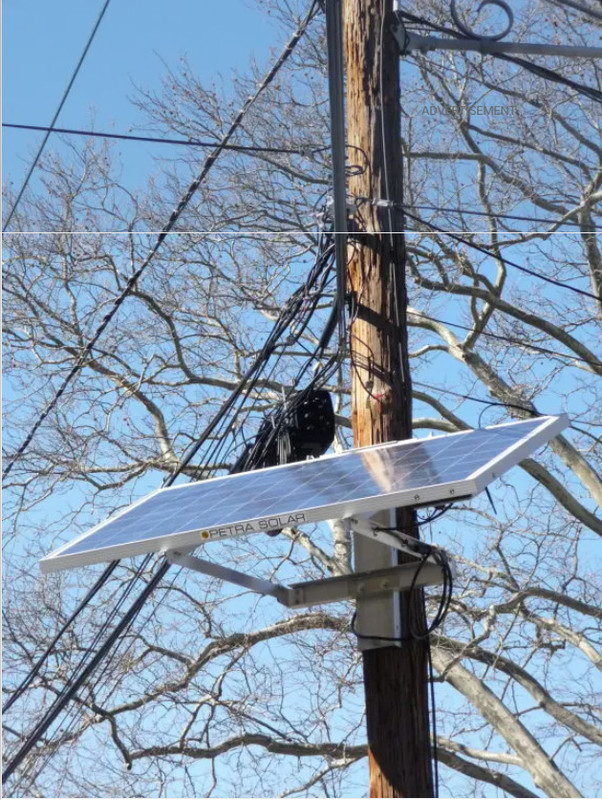
They're on every telephone pole on my block with one exception, that being the one that was ripped off the pole during Hurricane Sandy in 2012. The crumpled solar cell laid on the road for months on end, but eventually someone came around and hauled it away. Where it went, I have no idea, probably some landfill somewhere.
Power on my block was out for about two weeks, the wonderful solar cells on the telephone poles failing to relieve it.
The following is a screen capture from yesterday's tornadoes (3/14/2026 in Indiana, from the Weather Channel
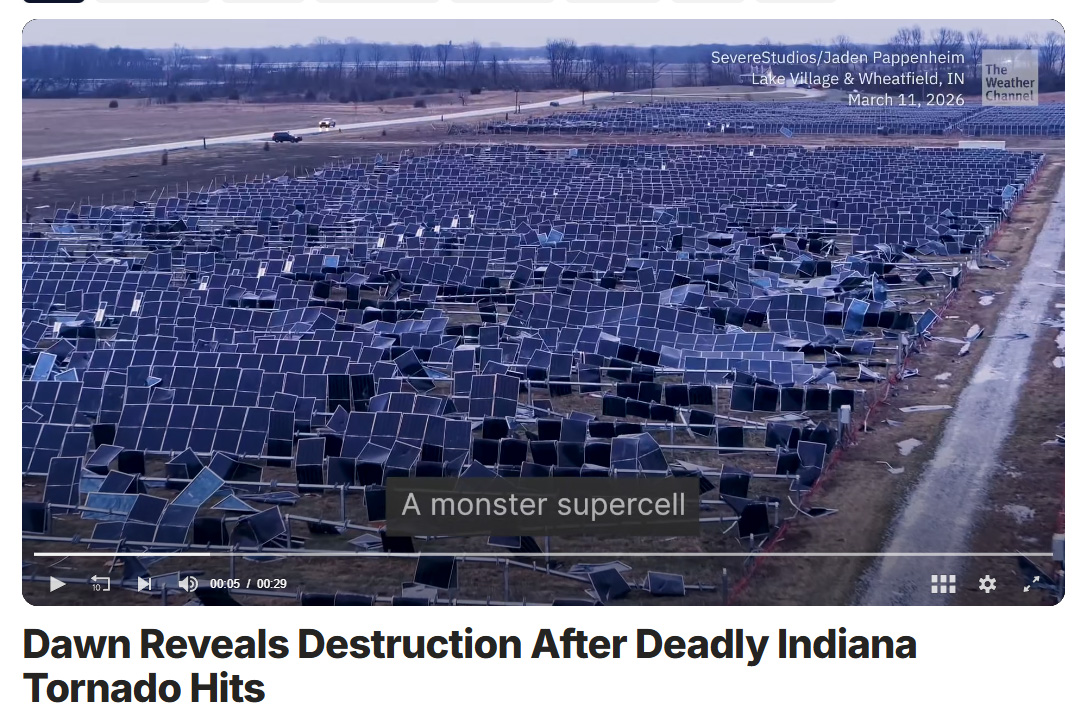
Dawn Reveals Destruction After Deadly Indiana Tornado Hits. The Weather Channel with Video Accessed 03/15/2026.
People may or may not note that decades of cheering about how solar energy would save the world has done nothing to arrest the growing extremities of weather associated with the collapse of the planetary atmosphere.
Extreme weather has a bad effect on solar installations apparently, as does time; solar cells have a lifetime of between 20 and 30 years, with output degrading continuously from effects related to Stabler-Wronski effect and thermal cycling. (Don't worry, be happy, the effect only operates when, um, the solar cells are exposed to, um, light, and happily it's often dark outside.)
Paul C. Okonkwo, Samuel Chukwujindu Nwokolo, Sunday O. Udo, Anthony Umunnakwe Obiwulu, Usang Nkanu Onnoghen, Saad S. Alarifi, Ahmed M. Eldosouky, Stephen E. Ekwok, Peter Andráš, Anthony E. Akpan, Solar PV systems under weather extremes: Case studies, classification, vulnerability assessment, and adaptation pathways, Energy Reports, Volume 13, 2025, Pages 929-959.
The review paper is free to read online, a few excerpts.
The paper begins with a discussion of, no matter how loudly we cheer that solar energy has something to do with addressing the collapse of the planetary atmosphere - it doesn't, things are getting worse faster:
Liang et al. report that global CO2 emissions from oil rose around 1.5 % in 2023 (Liang and You, 2023), primarily due to the transportation sector's dependence on oil as a fuel source. This persisted to escalate at a diminished pace compared to the global GDP, which grew by approximately 3.7 % in 2023. Liang et al. indicate that aviation-related CO2 emissions are projected to increase by 3.9 % in 2023 relative to the prior year (Liang et al., 2023), attributed to a significant rebound in air traffic following the global reopening post-COVID-19 pandemic. This increase was primarily attributed to a rise in long-haul flights, which produce higher emissions than domestic travel. Liang et al. reported that global energy-related CO2 emissions increased by 2.4 % in 2023 (Liang et al., 2023), marking the highest annual rise in over a decade. This increase was chiefly attributable to the economic recovery post-epidemic, with energy demand significantly rising in several regions. In 2023, emissions rose by approximately 2.4 billion metric tons of CO2, resulting in a total of 38.2 billion tons of energy-related CO2 emissions, a record high. This occurred in the context of a trend disturbed in 2022 by the rapid and emissions-intensive economic recovery post-COVID crisis…
...but sometimes they don't get to experience decades of degradation from exposure to light and heat...
Given the diverse effects of extreme weather events on solar PV modules and other life-threatening situations globally, one can conclude that climate change has emerged as a paramount issue of this century, prompting concern among geopolitical experts regarding its implications and necessitating a comprehensive global response...
...followed later by a discussion that solar manufacturing is hardly carbon free...
Don't worry; be happy.
Apparently the authors note that solar cells did great in the Tsunami that killed 20,000 people by drowning in seawater and being in collapsed structure in the Sendai earthquake in 2011 that famously caused the destruction of nuclear reactors at Fukushima, not that anyone gives a shit about the safety of coastal cities, especially when someone somewhere somehow might die from exposure to radiation from the event.
So there's that.
One of the "I'm not an antinuke" antinukes around here happily reported - perhaps "gloated" would be a better word - that nuclear energy will not save the world. I happen to agree with the person, albeit anything but happily, since I regard the demonization of nuclear energy over the last four decades, by people who know next to zero about the subject, as being responsible for the collapse of the planetary atmosphere.
Nevertheless, it appears that dependence on systems relying on weather is not going to save the world either, no matter how many times "I'm not an antinuke" antinukes come around here whining about climate effects.
I have reported elsewhere, albeit being too lazy to look for the link at this particular moment, that soothsaying predicts that solar PV waste will amount to approximately 80 million tons "by 2050" if, and only if, something isn't done about the affectation. That may or may not prove true since soothsaying is just that, soothsaying, but one thing is clear, exposure to extreme weather isn't good for systems that rely on weather to produce energy.
What a surprise!!!
Have a nice Sunday afternoon.
 = new reply since forum marked as read
Highlight:
NoneDon't highlight anything
5 newestHighlight 5 most recent replies
= new reply since forum marked as read
Highlight:
NoneDon't highlight anything
5 newestHighlight 5 most recent replies

HappyH
(216 posts)After a major hurricane near our home in Florida the power was out for a week or more. This was when cell phones were becoming popular and we noticed the cell phones would not work after a few days with no power even if fully charged. The problem was that there was a battery back up powered dohickie ( sorry for the tech term) that had to work and the back up batteries could not charge with no power. The phone company started putting gas generators at the base of the poles to power these whatever they ares and predictably people stole the generators. They chained the generators to the poles and people stole the generators and the chains.
Some years later we had another big storm, power goes out but phone service worked. The phone company had installed small solar cells as in your pic on the poles, up high where they are tough to reach. It’s nice to be able to call your mom and tell her you survived!

thought crime
(1,491 posts)It's so sad to hear that one was damaged in a hurricane 14 years ago. The technology is getting better all the time and damage from extreme weather will undoubtedly be reduced, while the recyclability of solar equipment is improved.