Environment & Energy
Related: About this forum
Coastal wetland deposition of cathode metals from the world's largest lithium-ion battery fire
The article to which I will briefly refer is this one: Aiello, I.W., Endris, C., Cunningham, S. et al. Coastal wetland deposition of cathode metals from the world’s largest lithium-ion battery fire. Sci Rep 15, 42113 (2025).
Scientific Reports is an open access journal and is free to read. I will excerpt a few bits of the article below in any case, but first a comment.
California features the highest electricity prices in the contiguous United States, despite the advancement of the big lie that so called "renewable energy' is "cheap." The explanation for the discrepancy is that advocates of "renewable energy" deliberately, and in my view dishonestly, ignore the environmental and economic costs of redundancy, the redundancy in most places involving the use of fossil fuels and the dumping of fossil fuel waste directly into the planetary atmosphere where it is killing it, and with it the planet.
I discussed this issue in a post here sometime ago, with reference to an article by Dr. Robert Idel:
LFSCOE: The True Cost of Solar and Wind Energy in Texas and Germany in Answer to the Question...
Dr. Idel has left academia, and now, last I looked, works for Trip Advisor, but despite his day job, like me, retains a private interest in Energy and the Environment. I follow the rise in citations of his excellent paper linked in that document, this one:
Robert Idel, Levelized Full System Costs of Electricity, Energy, Volume 259, 2022, 124905.
It's up to 56 citations, probably not enough, given its importance, but not all that bad for a guy who left academia and research.
The big lie connected with the lie that so called "renewable energy" is "green" is the bigger lie that energy storage is also "green." In California, still dependent on the dangerous fossil fuel "natural" gas, this lie on top of the lie has been to build huge battery facilities, which are themselves dependent on an unsustainable mining enterprise.
The largest battery facility in the world, that at Moss Landing, caught fire and these metals were disbursed into the environment, which is the point of the article. Happily the generation of hydrogen fluoride in the fire from the fluorocarbon dependence of lithium batteries did not to prove to result in fatalities. Hydrogen fluoride is the most dangerous chemical with which I have personally worked, and I worked, for many years with the historic war gas phosgene.
Happily, no Bhopal. How near a thing, I don't know.
Anyway, excerpts from the article:
Establishing robust environmental baselines in areas surrounding energy storage systems and achieving adequate spatial and temporal coverage to identify contamination after emergency release are both logistically difficult and often cost-prohibitive. In this context, portable and cost-effective technology such as X-ray fluorescence (FpXRF) offers a means of collecting high-density data, serving as a valuable complement to traditional laboratory-based analytical methods.
On 16 January 2025, a large fire engulfed the largest lithium-ion battery (LIB) Battery Energy Storage System (BESS) in the world, burning actively for at least 2 days. This was followed by a smaller reignition on 18 February 2025. Owned by Vistra Corporation, the BESS is in Moss Landing, California, immediately adjacent to Elkhorn Slough, a Ramsar site recognized as a wetland of international importance8. The fire affected the core of the facility (Phase 1) which had a capacity of 300 MW/1200 megawatt-hours (MWh) and was equipped with LG Energy Solution’s TR1300 battery rack systems9. The fire destroyed approximately 75% of the facility10 and produced a smoke plume visible from tens of kilometers away, depositing ash and soot across the surrounding area (Fig. 1a). Due to potential toxicity, including possible exposure to hydrogen fluoride, evacuation orders and road closures were issued. Residents were permitted to return 2 days after the fire began11...
A graphic from the article:
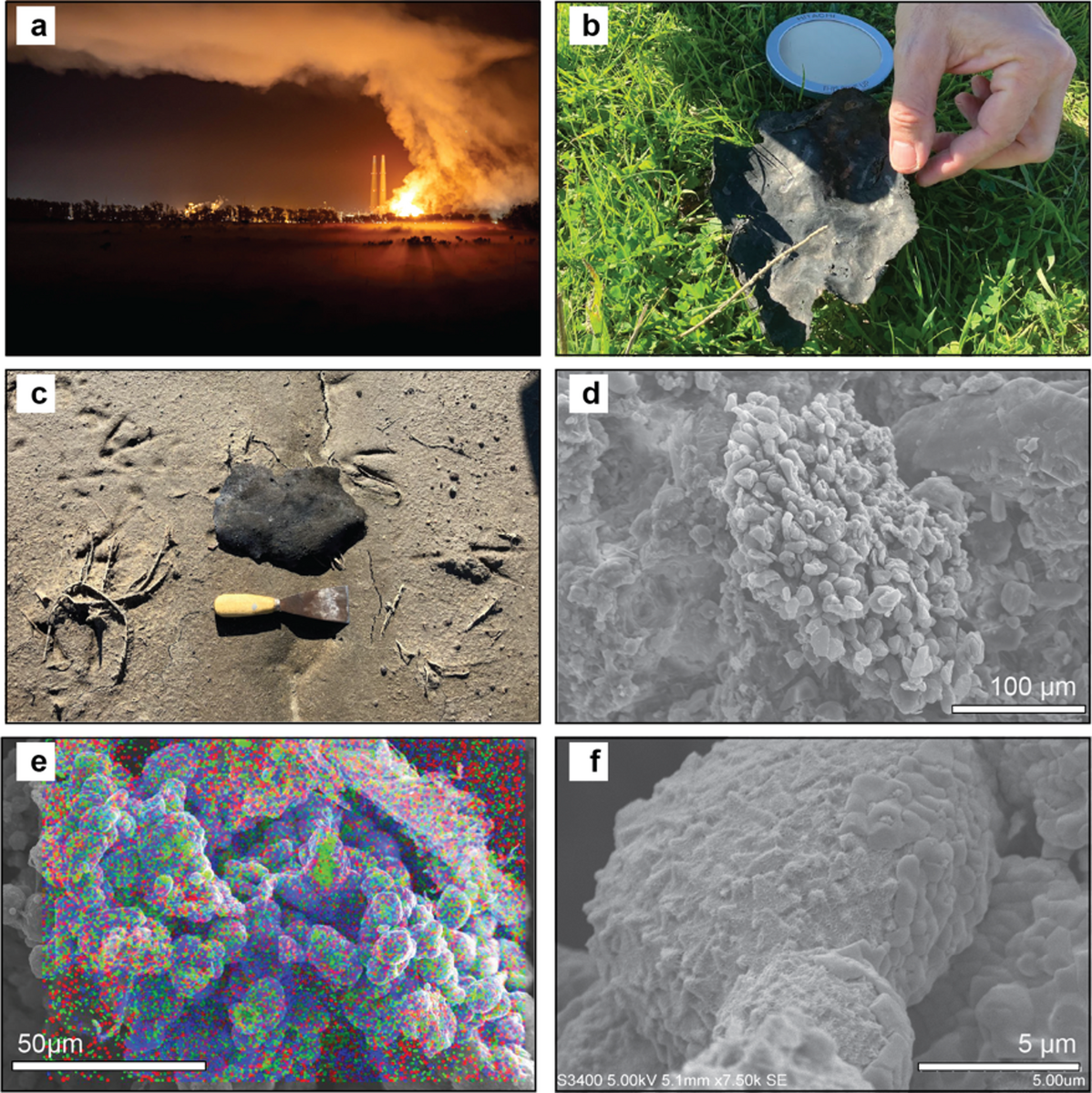 ?as=webp
The caption:
The authors note that the concentrations of the heavy metals subsided with inundation of the marshes by rain and tides, although the metals went somewhere, apparently to the local benthic zones, about which we couldn't care less, since we are happy to be converting them to wind turbine industrial parks in a malignant belief that wind turbines are "green."
Another comment from the paper:
These processes could affect both metal mobility and, over time, pose a threat to higher trophic levels through bioaccumulation. Ni, Mn, and Co are all known to be toxic to humans as well as to aquatic and terrestrial organisms20, and Mn toxicity is a major constraint limiting plant growth and production16. Co can have lethal or sublethal effects on reproduction in fish and crustaceans and has some bioaccumulation potential through adsorption to plant roots26. These risks are particularly acute at Hester Marsh, where an $18 M investment to restore tidal wetlands through soil augmentation raised marsh platforms to elevations intended to sustain native plant growth and survival under future flooding27...
Again, the full article is open sourced. If interested, anyone can read it.
I trust you're having a pleasant Sunday.