California
Related: About this forumSan Andreas fault reaches highest stress level in 1,000 years
https://mauinow.com/2026/06/15/san-andreas-fault-reaches-highest-stress-level-in-1000-years/Buckle up.
The study, recently published in the Journal of Geophysical Research: Solid Earth, has direct implications for seismic hazard assessments in one of the most densely populated and infrastructure-critical corridors in the United States.
“Our results show that stress levels on multiple fault segments are now at or above the highest values seen in the past millennium and that the region may be capable of a large through-going rupture involving both fault systems,” said lead author Liliane Burkhard in a press release.
Burkhard is a research affiliate at Hawai‘i Institute of Geophysics and Planetology in University of Hawai‘i at Mānoa School of Ocean and Earth Science and Technology.
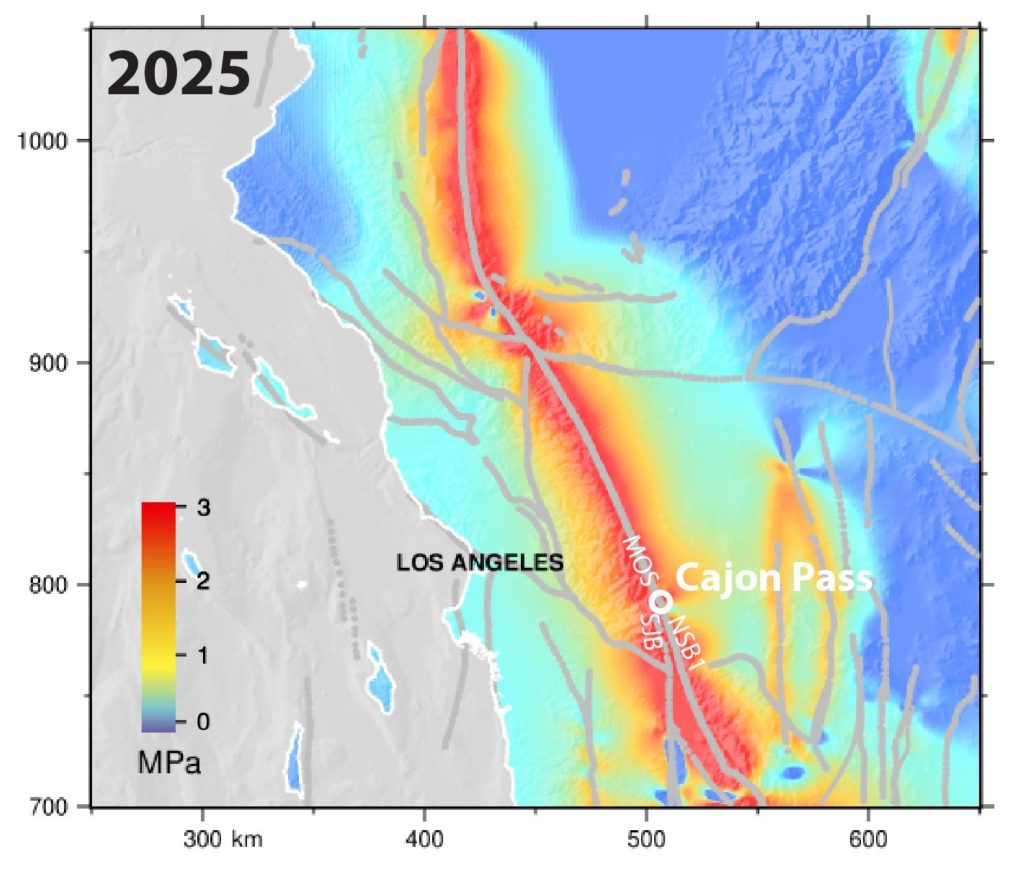
Report is open access, with pdf download available.
https://agupubs.onlinelibrary.wiley.com/doi/full/10.1029/2025JB033213
Plain Language Summary
Southern California's San Andreas and San Jacinto faults have not produced a major earthquake near Los Angeles in over a century. During that time, tectonic stress has continued to build along these faults, increasing the likelihood of a large future rupture. One key area of concern is Cajon Pass, where the two fault systems meet and could potentially rupture together. To investigate this, we used computer simulations of the last 1000 years of large earthquake activity to estimate how stress builds up on fault segments and affects neighboring segments over time. The model shows that stress has now reached high levels across the region and that the two fault systems may interact when their stress levels become similar. This suggests that Cajon Pass could act as an “earthquake gate” which sometimes blocks and other times allows large ruptures to propagate between faults. These results improve our understanding of earthquake interactions in Southern California and help refine regional hazard assessments.
 = new reply since forum marked as read
Highlight:
NoneDon't highlight anything
5 newestHighlight 5 most recent replies
= new reply since forum marked as read
Highlight:
NoneDon't highlight anything
5 newestHighlight 5 most recent replies

yellow dahlia
(6,783 posts)
2naSalit
(104,467 posts)The majority of my immediate family live west of the fault.

usonian
(26,955 posts)Make sure everyone is prepared. We used to treat it like camping in terms of supplies.
A related resource is the CalFire site https://readyforwildfire.org
It has helpful instructions on evacuation kits. Of course, wildfires can shut down an entire area, fire or not, so that firefighters can have access without traffic interfering, so this is useful info.
Try to arrange for emergency visits with relatives/friends, to avoid staying in shelters.
In my experience, counties have set up shelters for pets as well.
Of course, earthquakes can cause fires, as San Francisco learned in 1906, with its water system, so be doubly prepared.
2naSalit
(104,467 posts)Some moved there as kids. I lived there for a while but didn't like it there, earthquakes being a small part of it. I went and set up on top of the biggest pool of magma in the continental US so I wasn't all that concerned. When the quakes start around there, time to head for the caldera and get 'er done 'cause you can't outrun it.


msongs
(74,409 posts)
BidenRocks
(3,611 posts)When Northridge hit, mobile homes got very mobile. Many, and ours, jumped off the jack stands.
The doors were jammed and a crowbar opened a door. We crushed the gas line and other homes were burning,
Let's not do it again!
usonian
(26,955 posts)I'm in the central Sierras and, yes, snow sometimes blocks the storm door. All gas and water valves have big handles on the shutoffs.
I am over 100 miles from a fault, so one night, the home started shaking. A quake in Nevada went right through the Sierras. Go figure.
I actually do have a crowbar handy, more because I always forget to put it back in the shop.
Good luck going forward.