The DU Lounge
Related: Culture Forums, Support Forumsa brief history of barbed wire fence telephone networks
https://loriemerson.net/2024/08/31/a-brief-history-of-barbed-wire-fence-telephone-networks/Lori Emerson

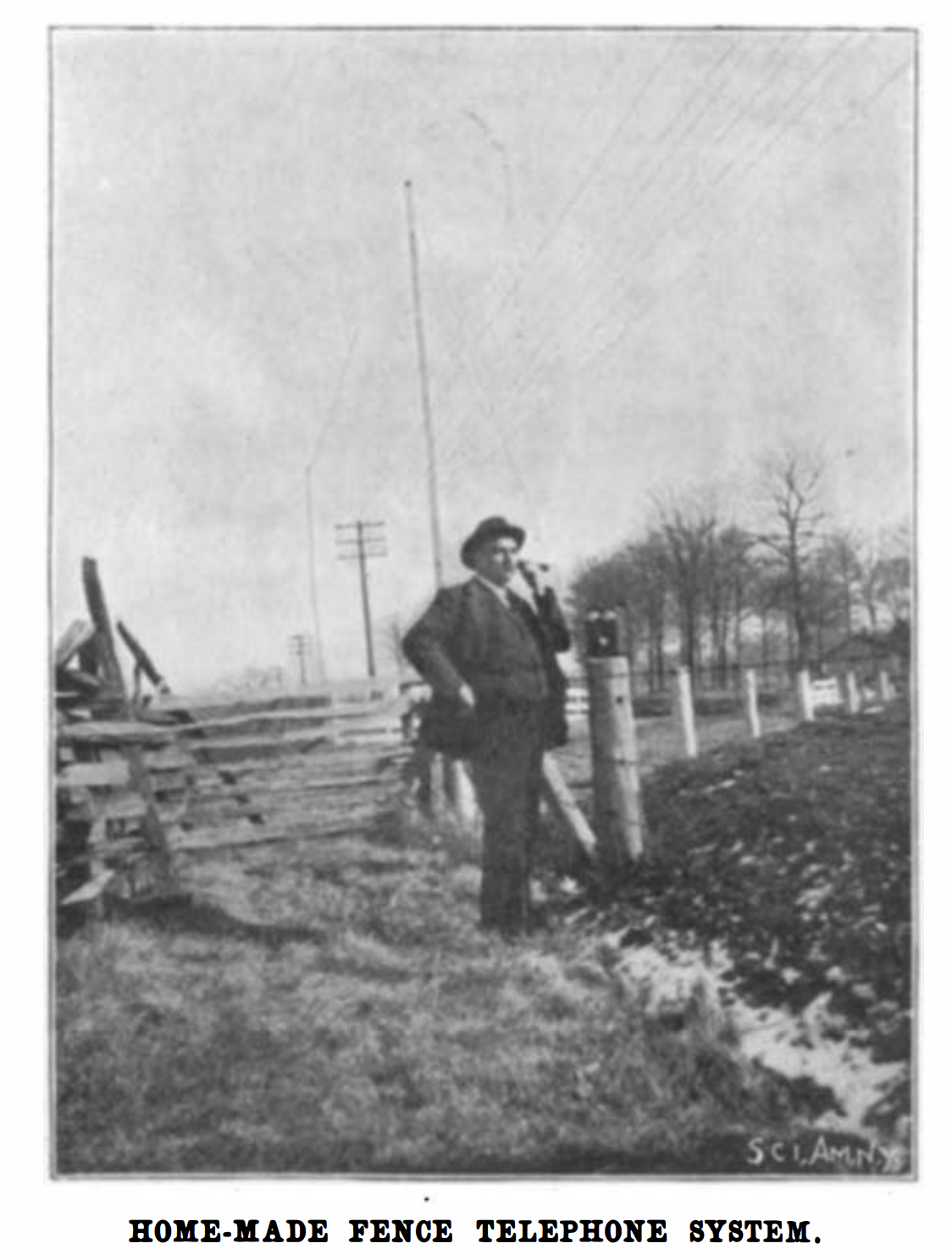
While I was researching barbed wire fence phones and wondering whether any artists had been intrepid enough to experiment with this other network, I came across Phil Peters and David Rueter's work "Barbed Wire Fence Telephone" which they installed in a Chicago gallery in 2015. libi striegl (Managing Director of the Media Archaeology Lab through which we run many of our Other Networks projects) and I decided we should see if we can get Peters and Rueter to re-install their barbed wire fence telephone on the CU Boulder campus...to our delight and surprise, they said yes. But even more delightful and surprising was the fact that the college I'm now based in, the College of Media, Communication, and Information (CMCI), was enthusiastically supportive of our ask to install this fence phone network in a university classroom! In fact, not only was CMCI supportive in principle, they helped fund the project and staff members even helped us drill holes, put up fence posts, and string barbed wire. Phil and libi (with modest assistance from me) wrapped up the installation of "Barbed Wire Fence Telephone II" on Thursday August 29th and on Friday August 30th Phil gave a group of about 20 people a hands-on demo of this ad hoc network.
Since so little documentation exists online about the history of this important communication network, below I include the introduction I wrote for the section on barbed wire along with the entry on barbed wire fence phones. I admit I hope someone adds this information to Wikipedia and cites either this post or Other Networks: A Radical Technology Sourcebook (forthcoming in 2025 by Anthology Editions).
***
Barbed Wire Networks
Barbed wire was originally proposed as an inexpensive and potentially painful material that could be used to create a fence and thus act as a deterrent to keep livestock within a confined area and/or to keep out intruders. Alan Krell documents numerous designs for wire that featured barbs throughout the 19th century, including one proposed by French inventor Léonce Eugène Grassin-Baledans in 1860 for a "Grating of wire-work for fences and other purposes." The first patent in the U.S. for a wire fence featuring barbs was given to Lucien B. Smith from Kent, Ohio (U.S.) in 1867. Illinois farmer Joseph Glidden submitted a patent for an improved version of barbed wire in 1874 which has since become the dominant design. As Reviel Netz puts it, after this point the physical control of wide open spaces was largely complete. Many farmers objected to the cruelty built into barbed wire, the way in which the fencing meant cattle drives were no longer possible, and the way it marked the end of seemingly free and open public land; notably they formed anti-barbed-wire associations and pleaded with legislators and government officials to enact laws limiting or regulating the use of the wire. Nonetheless, as the price of wire fell from twenty cents per pound in 1874 to two cents a pound by 1893, few ranchers could afford any other type of fencing material. By the 1890s, the barbed wire industry had become wealthy enough and powerful enough that they effectively quelled all opposition to the wire. The availability of inexpensive barbed wire, especially across the western U.S. in the late 19th century, largely made it possible to keep larger herds of livestock than had been possible up to that point. It also played a significant role in "settling" the American west by violently asserting individual ownership over land that was already occupied by Native Americans.
. . .
. . .
 = new reply since forum marked as read
Highlight:
NoneDon't highlight anything
5 newestHighlight 5 most recent replies
= new reply since forum marked as read
Highlight:
NoneDon't highlight anything
5 newestHighlight 5 most recent replies

underpants
(195,689 posts)Thanks. Very interesting

AllaN01Bear
(29,025 posts)where i live . the phone company started this way i have a calander that i bought at a book sale some where and was a history about the calaveras telephone co. it started with a farmer experimenting with telephones and then he ran a line from the house to the barm. other neighbors who saw that wanted one too. a friend whos dad started the local phone co here did that as well.

erronis
(23,262 posts)
Zackzzzz
(327 posts)I found that Barbed Wire Fences came from The Western Audit on You Tube.
What a great American history site, Thank You!!
My Dad worked at Illinois Bell and built the phones that were used after WW2.
I had a phone, intercom, in my bedroom.
I was such a pest, my Mom removed it.
erronis
(23,262 posts)Just now looking at one on the match companies (Diamond Match) and the death and disfigurement caused.
Thanks for highlighting this!

Brother Buzz
(39,748 posts)Horribly unreliable in rainy weather, and the farmers rejoiced when Pacific Bell finally strung lines to them.