Welcome to DU!
The truly grassroots left-of-center political community where regular people, not algorithms, drive the discussions and set the standards.
Join the community:
Create a free account
Support DU (and get rid of ads!):
Become a Star Member
Latest Breaking News
Editorials & Other Articles
General Discussion
The DU Lounge
All Forums
Issue Forums
Culture Forums
Alliance Forums
Region Forums
Support Forums
Help & Search
General Discussion
Related: Editorials & Other Articles, Issue Forums, Alliance Forums, Region ForumsWhy Does One Become A Collaborator? -- Digby - Anne Applebaum
https://digbysblog.net/2026/07/12/why-does-one-become-a-collaborator/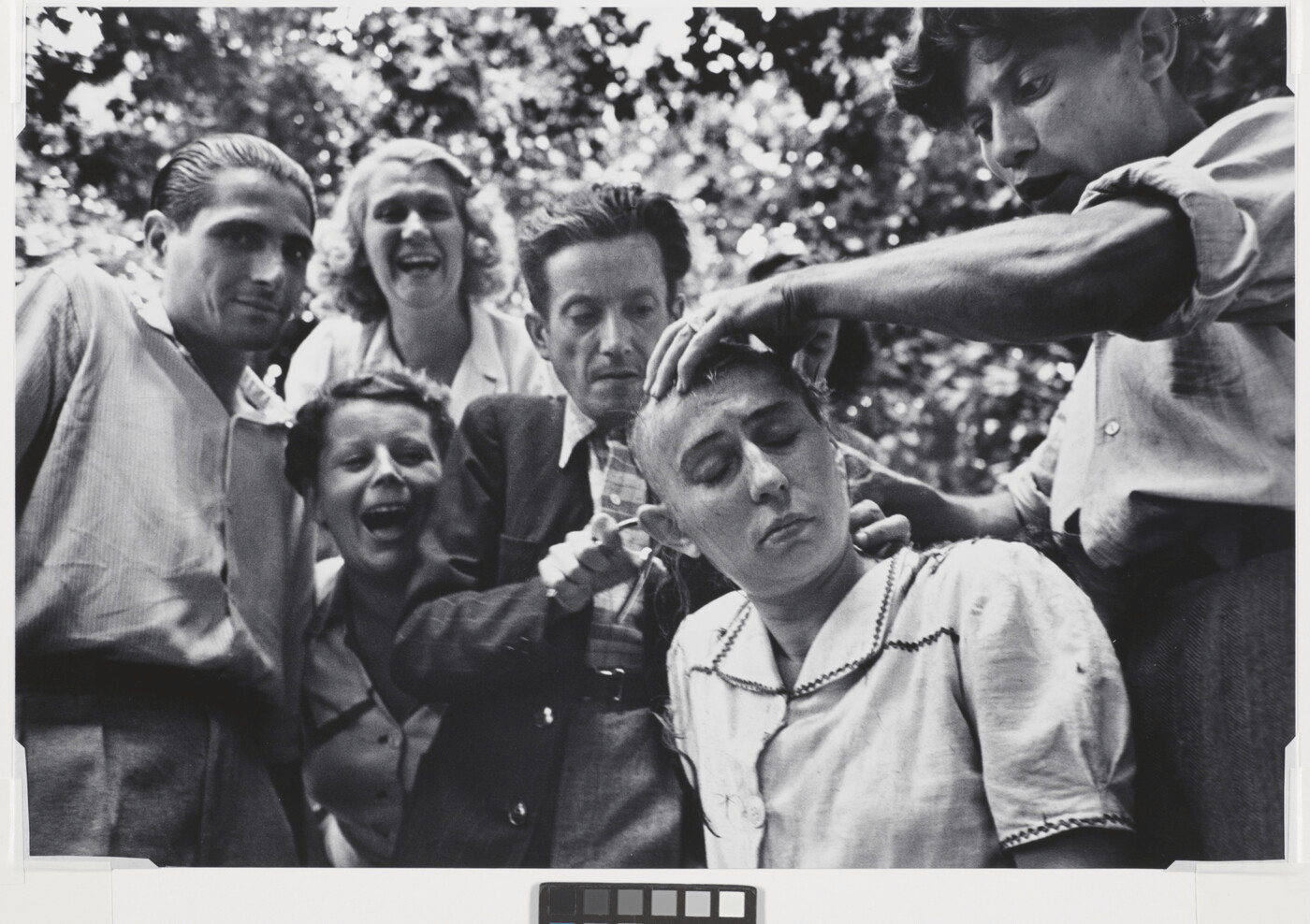
A French woman accused of collaborating with the Nazis has her head shaved after the war. About 20,000 women shamed in this way.
On the occasion of Lindsey Graham's passing, this piece (gift link) by Anne Applebaum from 2020 is making the rounds. It's about why some people decide to collaborate with an occupying force and others do not.
It's not hard to see how Republican officials as well as the elites break down under the Trump regime, is it?
Applebaum decides that, considering conformity is a pretty easy impulse to understand, she instead looks at why people don't collaborate, which is even more interesting. She takes up the different paths of Lindsey Graham and Mitt Romney. They both started out equally dismayed at the election of Donald Trump, considering him to be a man of low character and dull intellect, unworthy of the presidency. Serving as senators together, one held to that conviction while the other ... well, we all know what Lindsey Graham became.
. . .
Since the Second World War, historians and political scientists have tried to explain why some people in extreme circumstances become collaborators and others do not. The late Harvard scholar Stanley Hoffmann had firsthand knowledge of the subject--as a child, he and his mother hid from the Nazis in Lamalou-les-Bains, a village in the south of France. But he was modest about his own conclusions, noting that "a careful historian would have--almost--to write a huge series of case histories; for there seem to have been almost as many collaborationisms as there were proponents or practitioners of collaboration." Still, Hoffmann made a stab at classification, beginning with a division of collaborators into "voluntary" and "involuntary." Many people in the latter group had no choice. Forced into a "reluctant recognition of necessity," they could not avoid dealing with the Nazi occupiers who were running their country.
Hoffmann further sorted the more enthusiastic "voluntary" collaborators into two additional categories. In the first were those who worked with the enemy in the name of "national interest," rationalizing collaboration as something necessary for the preservation of the French economy, or French culture--though of course many people who made these arguments had other professional or economic motives, too. In the second were the truly active ideological collaborators: people who believed that prewar republican France had been weak or corrupt and hoped that the Nazis would strengthen it, people who admired fascism, and people who admired Hitler.
Hoffmann observed that many of those who became ideological collaborators were landowners and aristocrats, "the cream of the top of the civil service, of the armed forces, of the business community," people who perceived themselves as part of a natural ruling class that had been unfairly deprived of power under the left-wing governments of France in the 1930s. Equally motivated to collaborate were their polar opposites, the "social misfits and political deviants" who would, in the normal course of events, never have made successful careers of any kind. What brought these groups together was a common conclusion that, whatever they had thought about Germany before June 1940, their political and personal futures would now be improved by aligning themselves with the occupiers.
It's not hard to see how Republican officials as well as the elites break down under the Trump regime, is it?
Like Hoffmann, Czeslaw Milosz, a Nobel Prize-winning Polish poet, wrote about collaboration from personal experience. An active member of the anti-Nazi resistance during the war, he nevertheless wound up after the war as a cultural attache at the Polish embassy in Washington, serving his country's Communist government. Only in 1951 did he defect, denounce the regime, and dissect his experience. In a famous essay, The Captive Mind, he sketched several lightly disguised portraits of real people, all writers and intellectuals, each of whom had come up with different ways of justifying collaboration with the party. Many were careerists, but Milosz understood that careerism could not provide a complete explanation. To be part of a mass movement was for many a chance to end their alienation, to feel close to the "masses," to be united in a single community with workers and shopkeepers. For tormented intellectuals, collaboration also offered a kind of relief, almost a sense of peace: It meant that they were no longer constantly at war with the state, no longer in turmoil. Once the intellectual has accepted that there is no other way, Miłosz wrote, "he eats with relish, his movements take on vigor, his color returns. He sits down and writes a 'positive' article, marveling at the ease with which he writes it." Milosz is one of the few writers to acknowledge the pleasure of conformity, the lightness of heart that it grants, the way that it solves so many personal and professional dilemmas.
Applebaum decides that, considering conformity is a pretty easy impulse to understand, she instead looks at why people don't collaborate, which is even more interesting. She takes up the different paths of Lindsey Graham and Mitt Romney. They both started out equally dismayed at the election of Donald Trump, considering him to be a man of low character and dull intellect, unworthy of the presidency. Serving as senators together, one held to that conviction while the other ... well, we all know what Lindsey Graham became.
To the American reader, references to Vichy France, East Germany, fascists, and Communists may seem over-the-top, even ludicrous. But dig a little deeper, and the analogy makes sense. The point is not to compare Trump to Hitler or Stalin; the point is to compare the experiences of high-ranking members of the American Republican Party, especially those who work most closely with the White House, to the experiences of Frenchmen in 1940, or of East Germans in 1945, or of Czeslaw Milosz in 1947. These are experiences of people who are forced to accept an alien ideology or a set of values that are in sharp conflict with their own.
. . .
4 replies
 = new reply since forum marked as read
Highlight:
NoneDon't highlight anything
5 newestHighlight 5 most recent replies
= new reply since forum marked as read
Highlight:
NoneDon't highlight anything
5 newestHighlight 5 most recent replies
= new reply since forum marked as read
Highlight:
NoneDon't highlight anything
5 newestHighlight 5 most recent replies
Why Does One Become A Collaborator? -- Digby - Anne Applebaum (Original Post)
erronis
5 hrs ago
OP

sop
(20,137 posts)1. Knowing Trump much better now than we did back in 2017, it's not hard to imagine what he said to Graham
during their infamous round of golf at Trump National, the point where Graham shifted from a vocal Trump critic to one of his most sycophantic collaborators. Whatever dirt Trump had on Lindsey, his threats had the desired effect.

efhmc
(17,381 posts)2. How were/are any of these American people "forced" to follow the pedopres?

erronis
(25,236 posts)3. I'm sure the DOJ will dig into this with Ka$h leading the charge.
I'll guess it involves blackmail, extortion, and physical threats. Perhaps Lindsay didn't follow instructions?

Amaryllis
(11,606 posts)4. or they had kompromat on him....